Our previous post gives the scientifically precise definition of the Code On Time Digital Co-Worker:
"A heartbeat state machine with prompt batch-leasing that performs burst-iteration of loopback HTTP requests against a Level 3 HATEOAS API, secured by OAuth 2.0."
To a system architect, that sentence is poetry. To everyone else, it’s word salad.
So, let’s try a different language. Let’s talk about Jack Shephard from the TV show Lost (owned by Disney/ABC).
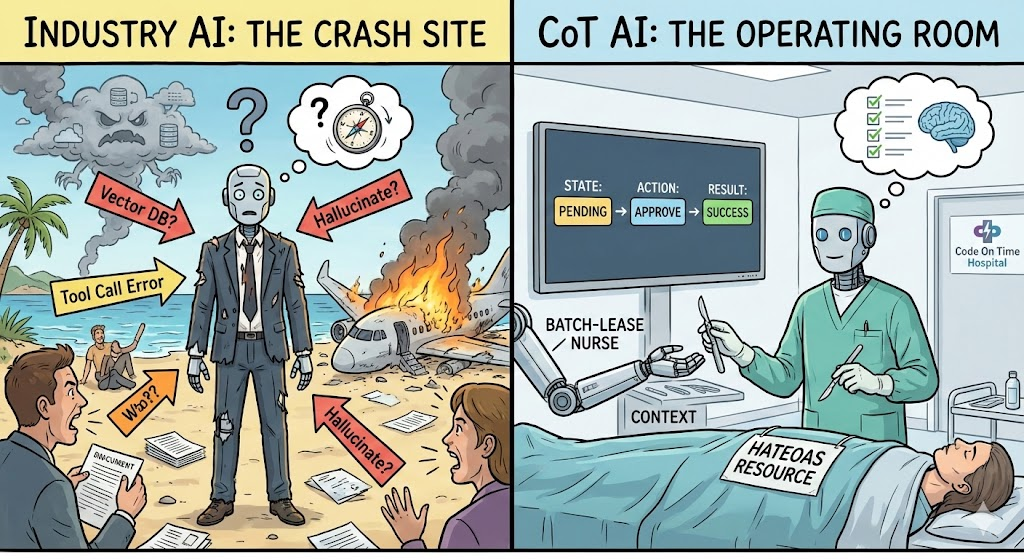
The AI at the Crash Site (The Industry Standard)
Imagine the pilot episode of Lost. The plane has crashed. There is burning wreckage everywhere. Passengers are screaming. Chaos reigns.
Jack Shephard, a spinal surgeon, wakes up in the bamboo forest. He is brilliant, capable, and highly trained. But what is he doing? He isn't performing delicate spinal surgery. He is running around screaming, "Who is hurt? Where is the water? Is that a polar bear?"
This is exactly how the modern software industry treats Artificial Intelligence.
When you drop a "Chatbot" into an unstructured environment (a vector database or a messy PDF repository) and text it "Hello," you are dropping Jack Shephard onto the island.
- The Context is Chaos: The AI has to figure out where it is every single time.
- The Cognitive Load is Massive: It spends 90% of its energy (and your money) just doing triage. "Is this user asking for an invoice? Or a pizza? Who am I again?"
- The Result: Your expensive "Hero" AI is wasting its brilliance on logistics. It hallucinates because it is stressed by the ambiguity.
The AI in the Operating Room (The CoT Approach)
Now, imagine a different scene.
Jack Shephard wakes up. The air is cool and sterile. The lights are bright. He is standing in a fully staffed Operating Room. On the table is a patient, draped and prepped. A chart hangs at eye level: "Patient: Order #101. Procedure: Approve Purchase."
There is no burning wreckage. There are no screaming passengers. There is only the patient and the procedure.
Jack doesn't ask, "Where am I?" He simply holds out his hand. A nurse places a scalpel in it. He makes the incision. He is done in 30 seconds.
This is the Digital Co-Worker.
How We Built the Hospital
That "word salad" definition we gave you earlier? That is just the blueprint for the hospital that makes the surgery possible.
- The Sterile Field (HATEOAS): We don't let the AI guess the patient's condition. The app provides a strict "State Representation" (the patient chart). The AI can only see the buttons and fields that are valid right now. It physically cannot "hallucinate" a database drop command because that instrument isn't on the tray.
- The Nursing Staff (Heartbeat & Batch-Leasing): The surgeon (AI) shouldn't be scheduling appointments or checking into the front desk. Our "Heartbeat" mechanism handles the queuing and logistics. It wakes the AI up exactly when the patient is ready, hands it the "context" (the scalpel), and puts it back to sleep the moment the cut is made.
- The Procedure (State Machine): In the ER, we don't improvise. We follow protocols. The State Machine ensures the AI moves from "Draft" to "Review" to "Approved" in a predictable line. It’s not an adventure; it’s a process.
Why "Residents" Beat "Heroes"
Here is the economic reality: Jack Shephard is expensive.
If you are operating at the "Crash Site," you need a hero. You need the smartest, most expensive AI model (like GPT-4-Opus) just to survive the chaos.
But if you are operating in a "Code On Time Hospital," you don't need a hero. You can use a Resident (a faster, cheaper "Flash" model). Because the environment is so structured—because the chart is clear and the nurse is helpful—the Resident can perform the appendectomy just as well as the Hero, but for 1/100th of the cost.
Conclusion: Don't Stress the Surgeon
We are currently in a hype cycle where companies are trying to build "Smarter Jacks." They think if they build a big enough brain, it can fix the plane crash.
At Code On Time, we decided to fix the environment.
We moved the AI out of the jungle and into the ER. We gave it a "State to Keep" and a "Resource to Act On." We stopped asking it to be a survivor and started letting it be what it was meant to be: A Professional.
Stop dropping your AI on an island. Build it a hospital.