In the world of mission-critical infrastructure, we have a sacred metric: The Four Nines.
Whether it’s a database, a payment gateway, or a cloud provider, 99.99% reliability is the minimum threshold for professional trust. It translates to less than an hour of downtime per year. We don’t accept a bank that loses one out of every ten transfers, nor a restaurant where the kitchen "hallucinates" the wrong order 10% of the time.
Yet, in the current AI gold rush, we are being told that 90% accuracy is a triumph.
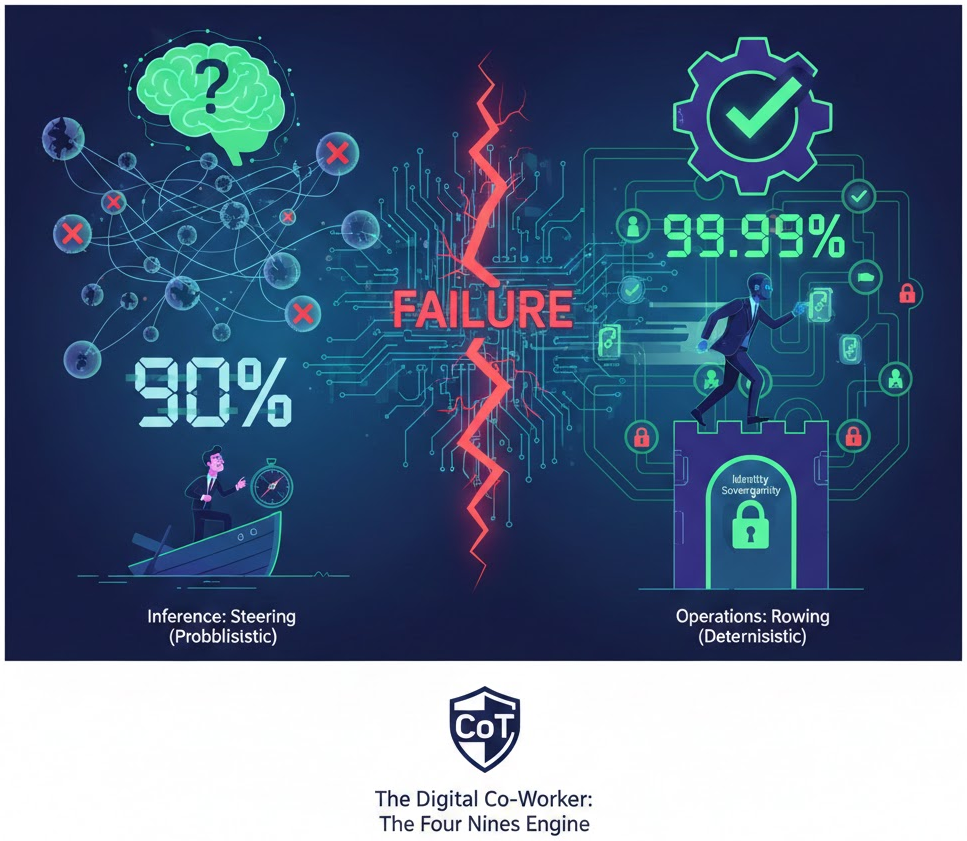
A recent research paper from Amazon on Insight Agents—a sophisticated multi-agent system designed to help sellers talk to their business data—proudly cites a 90% success rate based on human evaluation. While this is an impressive feat of linguistic inference, from an operational standpoint, 90% is a catastrophic failure. In the enterprise, if an agent isn't hitting "Four Nines," it isn't a worker; it's a liability.
The Probabilistic Trap: When "Inference" Isn't "Operation"
The gap between 90% and 99.99% isn't just a matter of "more training data." It is a fundamental architectural divide.
Most modern AI agents are built on a probabilistic model. They use LLMs as "Planners" that try to reason their way through a problem, generate a sequence of steps, and perhaps even write some SQL along the way.
- The Problem: LLMs are poets, not accountants. They are designed to predict the next most likely token, not to maintain the integrity of a transaction.
- The Result: Even with high-quality inference, these agents lack the proper security context and deterministic guardrails. They operate in a "God-mode" sandbox where they can imagine actions that shouldn't exist or bypass business rules because they "reasoned" it was the right thing to do.
If your restaurant's automated ordering system has a 90% accuracy rate, you don't have an innovation—you have a kitchen nightmare.
Where the Money Is: Steering vs. Rowing
To understand why this failure rate is so dangerous, we have to look at where value is actually created in the enterprise.
- Inference Helps Steer (The Compass): AI inference is fantastic at "steering." It can analyze sentiment, summarize reports, or suggest a new marketing strategy. If the AI is 90% accurate here, a human "Captain" can easily spot the error. This is high-value strategic insight.
- Operations Impact the Bottom Line (The Engine): This is where the "rowing" happens. This is the AI actually executing a refund, moving inventory, or updating a sensitive customer record.
In Operations, there is no room for a "likely" answer. A transaction is either valid or it is a bug. When an AI "Digital Co-Worker" operates your business at machine speed, any percentage of error is magnified. You don't get rich by having an AI that can discuss your business; you get rich by having an AI that can operate it with total reliability.
The Inversion: AI as the "Super-User"
How do we close the 10% gap? We stop treating the AI as a Developer and start treating it as an Expert User.
Instead of asking the AI to "plan" its own path (which leads to hallucinations), we build a Maze—a deterministic data graph—and ask the AI to navigate it. At Code On Time, we do this using REST Level 3 HATEOAS (Hypermedia as the Engine of Application State).
- The Maze is Human-Made: The developer defines the business rules. If an invoice is "Paid," the server physically does not render a "Delete" link. The AI cannot "hallucinate" a deletion because the button doesn't exist in its universe.
- The AI is a Super-Hacker: The AI "surfs" this data graph at machine speed. It doesn't need to know the database schema; it just needs to pick the most likely "link" from a pre-vetted list of valid actions.
- The Responsibility is Human: If the AI makes a "wrong" move, it’s because the developer drew the maze wrong. This moves the problem from the "unfixable" realm of LLM weights to the "fixable" realm of application logic.
Reclaiming the Throne
By "rigging the game" this way, we reclaim 99.99% operational certainty.
The AI provides the speed and the quality of decision-making (the Inference), but the Digital Co-Worker architecture provides the safety and the security (the Operation). The AI acts as your Human Alter-Ego, managing `access_token` and `refresh_token` through a secure public address loopback, ensuring it can never exceed the authority you’ve granted it.
The real prize of AI integration isn't a smarter chatbot; it's a Digital Co-Worker that lets you deploy a workforce that is faster than a human, but just as grounded in your business rules.
In the enterprise, we don't need AI to be "creative" with our data. We need it to be perfect. And with the right architecture, perfection is finally a deterministic outcome.